
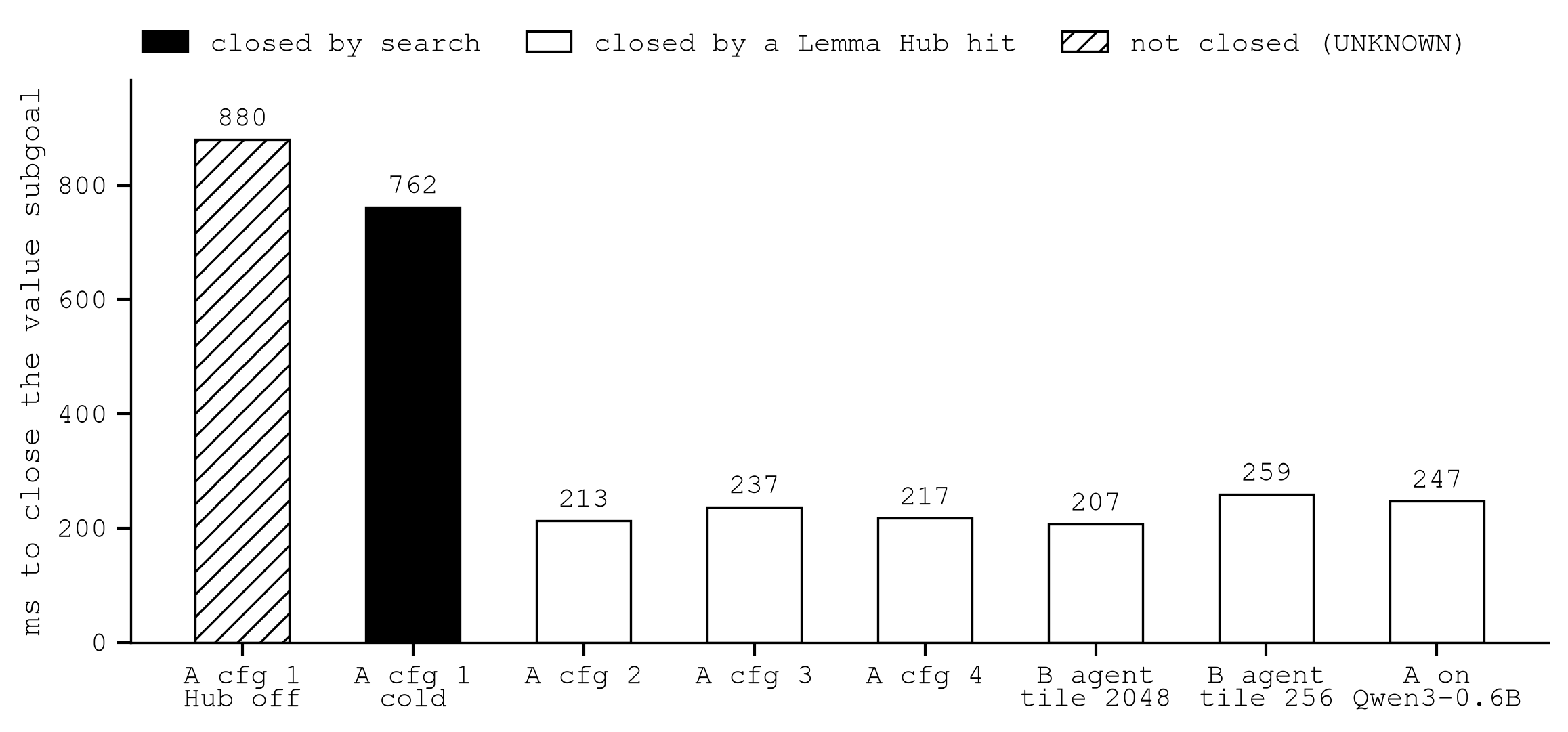
theformalera verify per step. Each step is a new program (new IR, so no result-cache hit), and the Hub’s admission check runs between steps. “Value subgoal” is the time tfe_close spent inside Lean closing the certificate’s value subgoal.
What it shows
- With the Hub off, the kernel is UNKNOWN; with it on, it is PROVED. Without the built-in identity
tanh_eq_exp, generic search (ring_nf,field_simp, the exp / sinh / cosh rewrites) cannot close the tanh-SiLU subgoal. The verdict is UNKNOWN, never PASS. - Once a lemma is deposited, later verifications hit instead of searching. The value subgoal drops from 762 ms to 204–259 ms (3–3.7×) for every later autotune config, for another team’s implementation with a different layout and operation order, and for a different model. This works because the canonical subgoal ignores tile sizes, code layout, operation order and, for operator-level lemmas, the model constants.
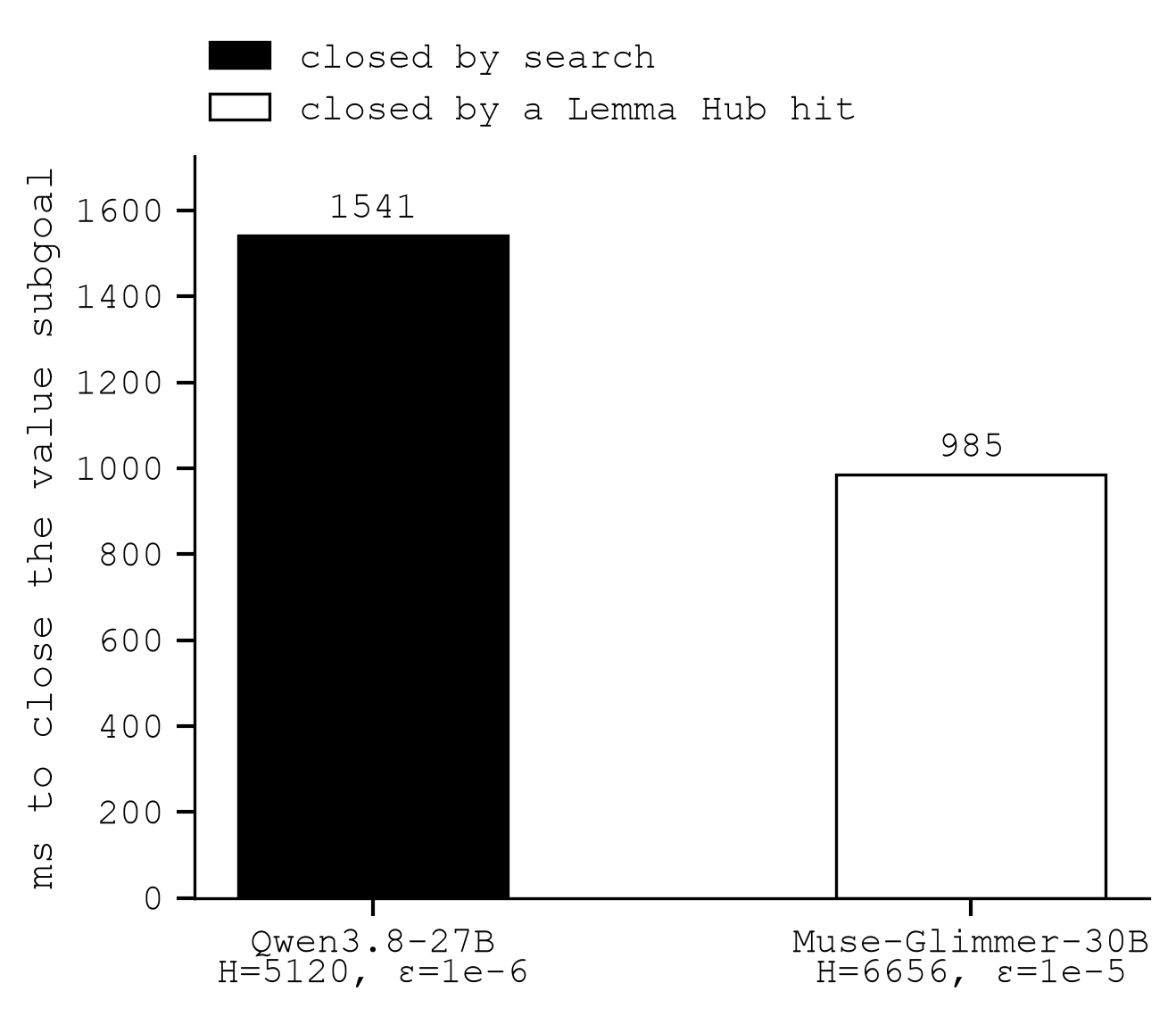
- Operator-level lemmas cross model families. The RMSNorm lemma was proved with
Handεsymbolic on Qwen3.8-27B, and hit on Muse-Glimmer-30B. - Lemmas change speed, never verdicts. A kernel that is wrong for its model (8c) is FAILED, with the same counterexample, however full the library is.
What it does not show
- The scale is seconds, not minutes. A whole proof check of these kernels takes about 3 s, of which about 2.1 s is Lean loading Mathlib. The Lemma Hub’s effect today is UNKNOWN → PROVED, plus a 3–4× faster value subgoal. It is not yet visible as minutes saved per kernel.
- End-to-end wall time per step is 3.4–12.7 s, dominated by lowering and Lean start-up. Steps 2 and 8b also compile the lemma pack once (4.6–4.8 s, cached afterwards).
- The structural lemmas where the savings should be large (online softmax, split-KV merge, the chunked delta rule) are proved and audited, but not wired into the proof generator yet. Attention and Gated DeltaNet kernels stay UNKNOWN for now.
At scale: 48 organisations, 319 kernels
The same mechanism, measured across a community instead of one node. Sixteen organisations, then 32 more, verify their own Triton kernels for the seven public models against one shared Lemma Hub: 382 configurations in all, on NVIDIA sm_80 to sm_100a and AMD gfx942 / gfx950. Each one is compared with the same project verified against an empty library. The metric that matters is how fast the N-th independent implementation of an operator verifies: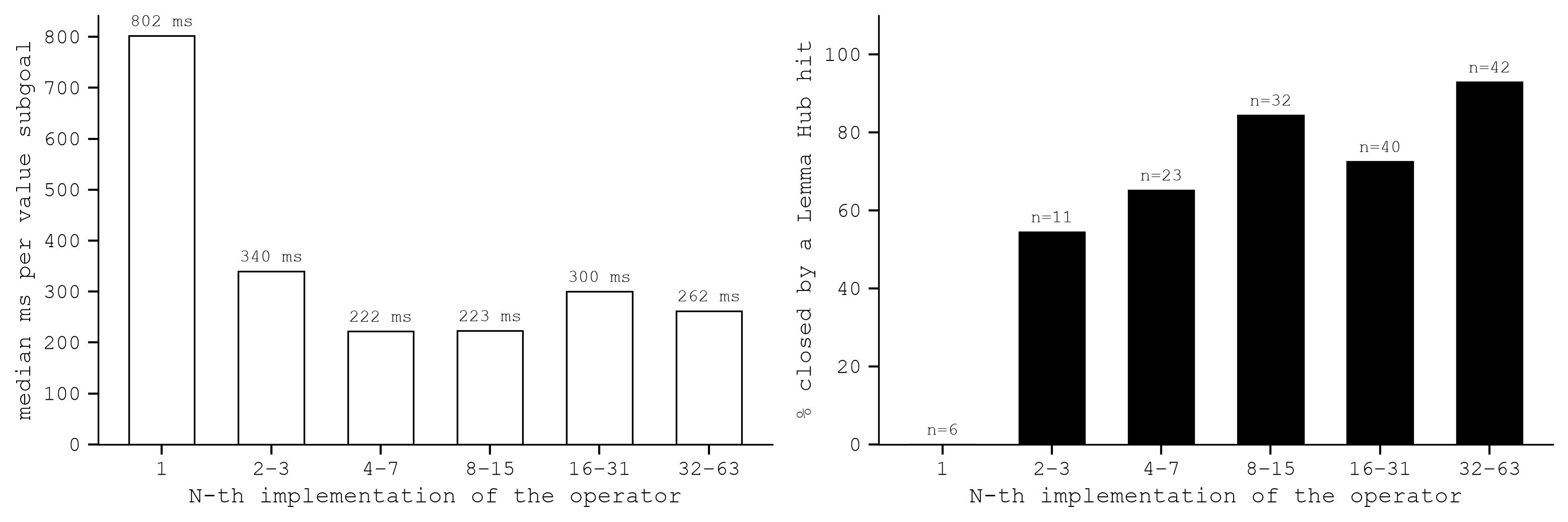
- Over all 48 users, 116 of 154 non-trivial value subgoals (75%) are closed by a lemma someone else deposited, and the time spent on them is halved.
- New idioms show up as a dip: users 17–24 bring norm and GELU forms nobody had written, and the hit share falls before the community’s deposits bring it back.
- The public library holds 23 lemmas at the end. Lemmas deposited by NVIDIA projects close the subgoals of AMD projects, because a lemma statement never mentions the target.
- All 382 configurations get the same verdict with and without the community: 313 PROVED, 49 real bugs FAILED, 16 UNKNOWN.
supporting-materials/ (dataset/scale/, logs/scale/, scripts/scale.py).
Reproduce it
The per-step JSON reports are insupporting-materials/logs/flywheel-runs/. The script that sets up a fresh Hub and runs every step is supporting-materials/scripts/flywheel.py: