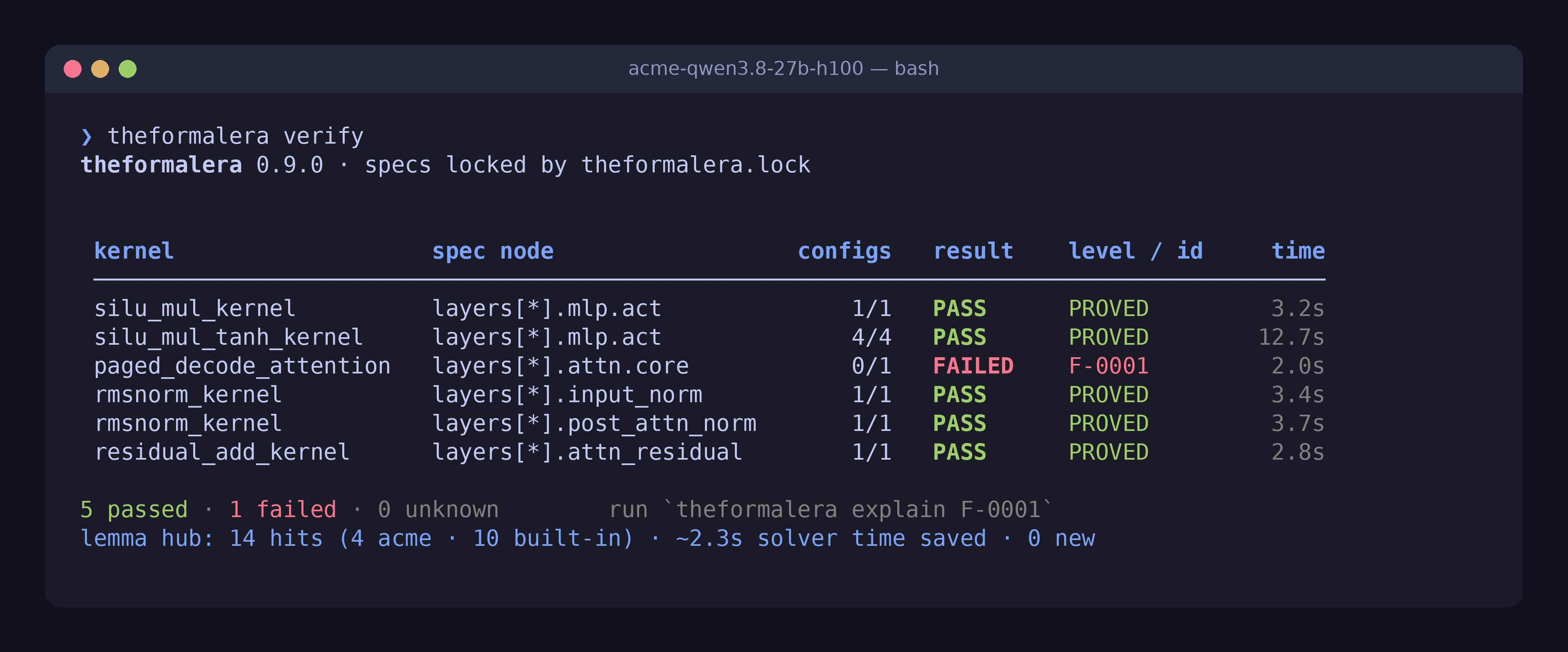
theformalera verify fetches that node’s Lean 4 specification from Spec Hub and returns a verdict. No GPU is needed.
Start here
Quickstart
Verify the example repository on your machine in about ten minutes.
Tutorial: onboard a repository
Annotate, pull, verify, fix a bug, gate CI and sign off a release.
How it works
From kernel source to a Lean 4 certificate: what is proved, and what is trusted.
Supported models
Lean 4 specs for eight models, from Qwen3-0.6B to Muse-Glimmer-30B.
What you get
A correctness test in CI, not a research project
A correctness test in CI, not a research project
You write annotations and read reports. You never write Lean. Verification runs as a required check next to your unit tests. The GitHub Action posts a PR comment and line annotations (SARIF).
Proofs over every shape, not samples
Proofs over every shape, not samples
A PROVED kernel is correct for every shape in the model’s domain (for example, every
T from 1 to 262,144), not just the shapes a test happened to try. Every @triton.autotune config is verified, because any of them can be picked at runtime.Honest verdicts
Honest verdicts
When the engine cannot decide, the result is UNKNOWN, never PASS. Bugs in safety and numerics are reported too: out-of-bounds accesses, data races, integer overflow and float overflow.
Verification that gets faster with use
Verification that gets faster with use
Reusable sub-proofs are stored as lemmas in the Lemma Hub. Later kernels, autotune configs and models cite them instead of searching again. Lemmas only change speed, never verdicts.
Specs you can trust
Specs you can trust
Each model’s Lean 4 spec is checked against the official Hugging Face implementation, layer by layer, in float64. The same check works on your own PyTorch implementation.